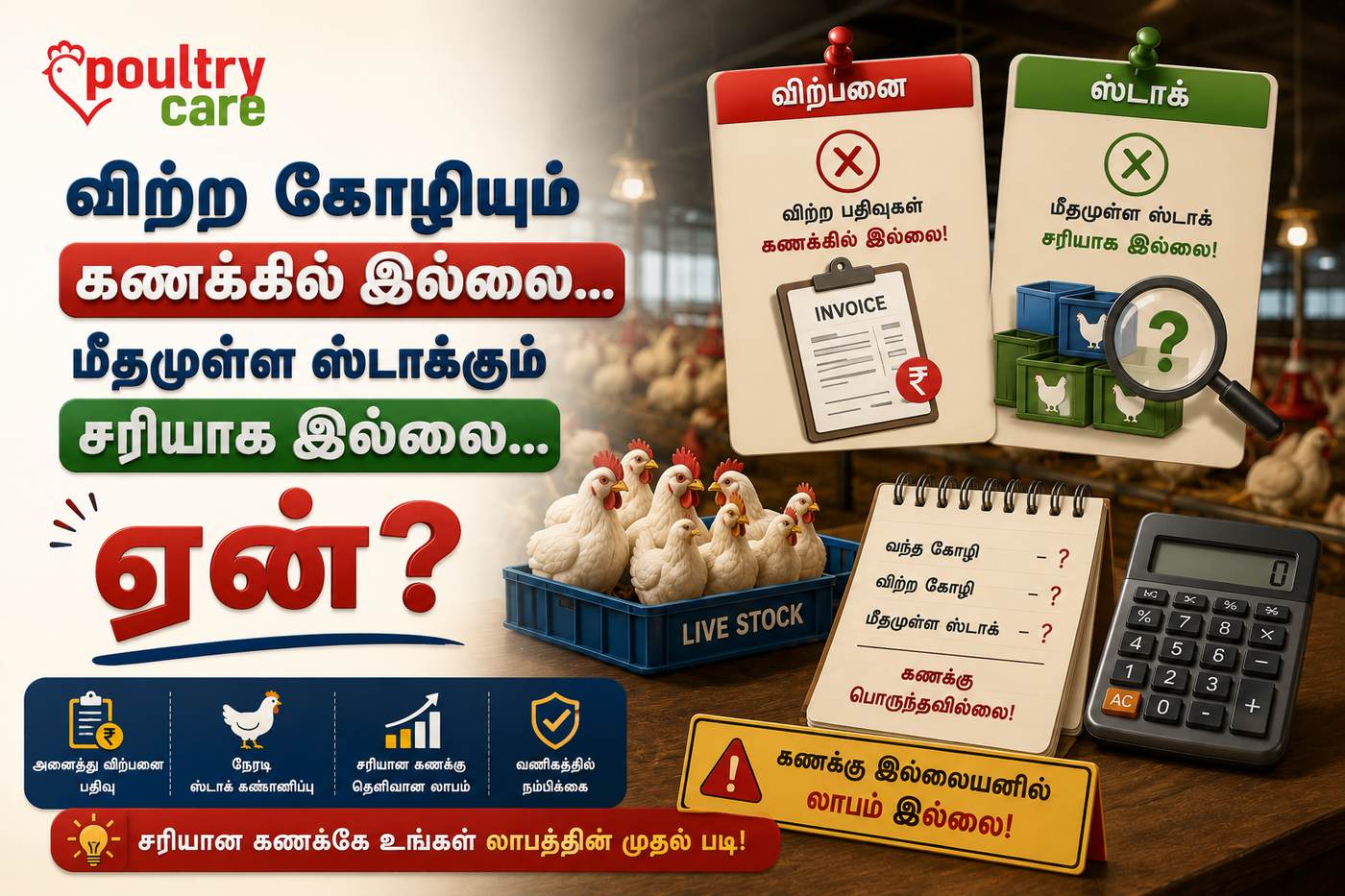

Month end is supposed to bring clarity. It should tell whether the business earned profit or faced loss. But for many poultry traders, month closing brings stress instead of confidence.
Books show one number.
Ground reality shows another.
Bird count never matches expectations.
Farmers and traders often spend long hours checking registers, calling supervisors, and rechecking delivery slips, trying to understand where the difference came from. Yet the answer rarely appears clearly.
The truth is simple but uncomfortable. Month end stock mismatch does not start at month end. It begins quietly every day.
Stock Problems Begin with Daily Assumptions
In poultry trading, operations move fast. Birds arrive, birds leave, vehicles move continuously, and decisions are taken quickly. Because of this speed, many daily activities depend on assumptions rather than confirmation.
A supervisor may estimate remaining birds instead of counting. Mortality might be recorded later. Transfer entries may be postponed until evening. Sales entries sometimes wait until billing confirmation.
Each delay feels small and harmless at the moment. But when these small assumptions accumulate across many days, records slowly drift away from reality.
By the time month end arrives, the business is trying to match numbers that were never aligned in the first place.
Stock mismatch is rarely a single mistake. It is the result of many unnoticed daily gaps.
Loading and Dispatch Create the First Difference
One of the biggest reasons stock never matches is the loading process.
When birds are dispatched, teams focus mainly on speed. Vehicles must leave on time, markets are waiting, and operational pressure is high. During this rush, exact counting sometimes becomes secondary.
Cages are assumed full. Counts are rounded. Adjustments are made mentally instead of being recorded immediately.
If loading quantity differs slightly from recorded quantity, the system already carries an invisible error.
Later, when delivery numbers are compared, confusion begins. Was the farm count wrong? Was loading inaccurate? Or was delivery counted differently?
Because verification was weak at dispatch, answers remain unclear.
Transport Stage Adds Hidden Variation
Between dispatch and delivery lies a stage many traders underestimate — transport.
Birds experience travel stress, environmental changes, and handling variations. Small mortality or condition changes may occur during transit. Sometimes these are recorded properly, but often they are noted only verbally.
When transport details are not documented immediately, stock records remain unchanged while reality changes.
At month end, these unnoticed variations appear as unexplained shortages.
Transport does not just move birds. It changes stock condition. Without tracking this stage carefully, stock accuracy becomes impossible.
Delivery Confirmation Is Not Always Final Truth
Many traders believe delivery count is the final accurate number. But delivery counting itself can vary.
Different customers follow different counting methods. Some count cage wise, some estimate visually, and some rely on previous agreements.
If delivery counting differs from dispatch counting, disagreements arise. Adjustments are made later to maintain relationships with buyers.
These adjustments often enter records days after the transaction.
When corrections are delayed, the stock timeline breaks. Records no longer reflect when changes actually happened.
Month end reconciliation then becomes guesswork rather than analysis.
Manual Recording Delays Reality
A common pattern across poultry trading businesses is delayed data entry.
Daily operations happen in real time, but records are updated later. Sometimes entries are completed at night. Sometimes at week end. Occasionally only during accounting review.
When records lag behind operations, visibility disappears.
Managers believe stock exists because records show it, while physically birds may already be sold or transferred.
This gap between physical movement and recorded movement is the biggest reason stock never matches during closing.
The issue is not lack of effort. It is lack of real time recording discipline.
Adjustments Become a Habit Instead of a Warning
When mismatch appears month after month, many businesses develop a dangerous habit — adjustment entries.
Instead of identifying root causes, differences are balanced through corrections.
Stock adjusted.
Loss adjusted.
Shortage written off.
Gradually, adjustments become normal practice.
But adjustments hide operational problems. They do not solve them.
Over time, businesses lose the ability to understand where profit is actually leaking.
True control begins when mismatches are investigated, not adjusted.
Visibility Changes the Entire Trading Mindset
The most successful poultry traders do not wait for month end to understand stock. They treat stock visibility as a daily responsibility.
Every movement is confirmed when it happens. Every transfer is recorded immediately. Every mortality is updated without delay.
When daily visibility improves, month end becomes simple verification rather than investigation.
Confidence replaces confusion.
Teams stop arguing about numbers and start focusing on improving performance.
Stock management then becomes a decision tool, not an accounting problem.
Coordination Is the Real Solution
Stock accuracy depends less on counting skills and more on coordination.
Farm teams, loading staff, drivers, and delivery handlers must operate with shared understanding. Each stage must communicate clearly with the next.
When coordination is weak, information breaks during handover. Each department assumes another team recorded the change.
But when coordination improves, stock flows smoothly from farm to customer with complete traceability.
The business gains something more valuable than numbers — operational clarity.
Month End Should Confirm Profit, Not Create Doubt
Month end closing should answer important business questions.
Did operations run efficiently?
Which routes performed better?
Where can improvement happen next month?
But when stock does not match, all attention shifts toward finding missing birds instead of planning growth.
Accurate stock management transforms month end from a stressful exercise into a strategic review.
It allows traders to trust their numbers and make confident decisions.
Final Thought
Stock mismatch is not a mystery. It is a message.
It tells the business that visibility was lost somewhere between daily operations. Birds were moved, but information did not move with them.
When tracking becomes consistent and coordination improves, mismatches slowly disappear.
The goal is not perfect counting once a month.
The goal is continuous awareness every day.
Because in poultry trading, profit is protected not only by selling birds — but by knowing exactly where every bird stands at every moment.