Which Broiler Farm Needs Your Supervisor Today? A Smarter Approach to Contract Broiler Farming
How daily farmer updates can help Tamil Nadu's poultry integration companies identify farm problems earlier, improve field supervision, and support better flock performance.
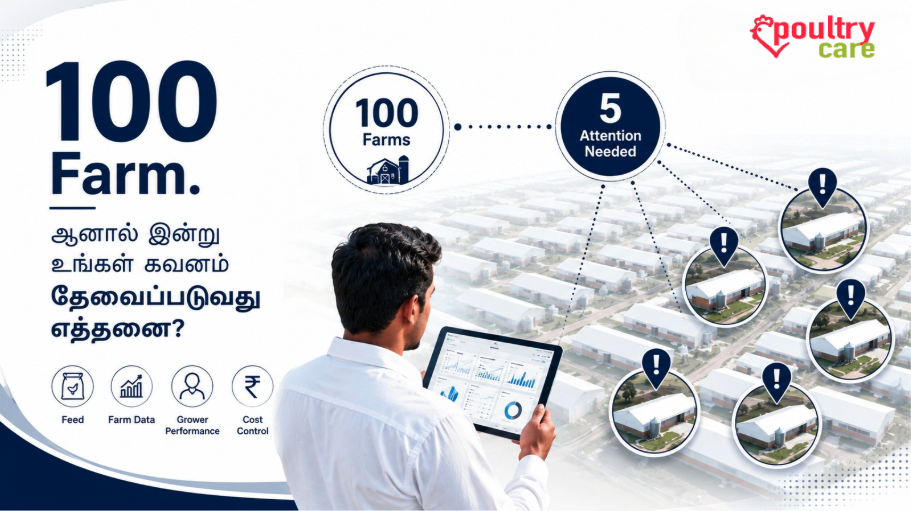
The Farm May Have a Problem Before Your Supervisor Arrives
Imagine a normal morning at a broiler integration company in Palladam, Tamil Nadu.
The farm supervisor begins the day with a planned route. There are farmers to meet, birds to inspect, feed requirements to check, and management instructions to provide. Every farm needs attention, and every farmer expects guidance.
The supervisor starts visiting farms according to the schedule.
Meanwhile, another farm on the same route may already be facing unexpected mortality. A farmer may be running low on feed. At another farm, the birds may not be gaining weight as expected.
These problems may already be affecting farm performance, but the supervisor has not yet reached those farms.
By the time the supervisor arrives, the situation may require more attention than it would have earlier.
This raises an important question for every contract broiler integration owner:
“If a farm needs attention today, why should we wait for the next supervisor visit to know about it?”
For poultry businesses managing contract farms across Palladam, Namakkal, Coimbatore, Tiruppur, and other poultry-producing regions of Tamil Nadu, this is a familiar operational challenge.
Farm supervisors work hard. Farmers manage their birds every day. Integration companies provide chicks, feed, technical guidance, and operational support.
Yet important information can still arrive late.
The challenge is not simply the number of farms under management. It is knowing what is happening at each farm while there is still an opportunity to respond.
A supervisor cannot physically remain present at every farm throughout the day. However, an integration company should not have to depend entirely on physical visits to understand daily farm conditions.
The real opportunity is to make farm information available before the supervisor arrives.
This is where farmer-led daily reporting can change how contract broiler operations are monitored and managed.
Why Traditional Farm Supervision Can Delay Important Decisions
Contract broiler farming works through close coordination between the integration company, the farm supervisor, and the farmer.
The integration company typically provides chicks, feed, veterinary or technical support, and production guidance according to its contract arrangements.
The farmer is responsible for day-to-day rearing activities, observing the flock, maintaining the shed environment, managing feeding and drinking systems, and following recommended farm practices.
The supervisor connects these activities by visiting farms, reviewing flock conditions, providing guidance, and communicating important observations to the company.
This relationship is essential for successful poultry integration management.
However, the traditional supervision process can create an information gap.
Consider a supervisor responsible for farms spread across different villages near Palladam.
During each visit, the supervisor checks mortality, feed consumption, bird condition, body weight, and other operational details. The information is recorded and shared with the company.
But what happens between visits?
A farmer may notice an unexpected increase in mortality. Feed consumption may suddenly decline. The available feed may be insufficient until the next delivery. Bird growth may not be progressing as expected.
If these observations are not communicated promptly, the company may remain unaware until the next visit or phone call.
The supervisor might be visiting a farm operating normally while another farm requires immediate attention.
This does not mean the supervisor is doing anything wrong.
It means the farm's condition and the supervisor's visiting schedule are not always aligned.
A farm problem can begin at any time. A supervisor's visit happens according to a planned schedule.
That difference can delay awareness and follow-up.
In broiler farming, early identification matters because mortality, feed intake, environmental conditions, and growth performance are closely connected.
Unexpected mortality may indicate a health or management concern requiring prompt assessment. Reduced feed consumption may be associated with environmental stress, health problems, feed quality, or changes in flock behaviour.
Poor body-weight development may require a closer review of feeding practices, flock health, and environmental management.
These observations do not automatically identify the cause of a problem. They are signals that need proper investigation.
When the information reaches the responsible team earlier, there is a better opportunity to assess the situation and decide what action is appropriate.
The solution is not to replace physical farm supervision.
It is to help supervisors understand farm conditions before deciding where their attention is needed most.
How Daily Farmer Updates Create Better Farm Visibility
The contract farmer spends more time with the flock than anyone else involved in the operation.
The farmer observes bird behaviour during feeding, notices changes in mortality, checks feed availability, and follows the flock's daily development.
This makes the farmer an important source of operational information.
Traditionally, much of this information is recorded in registers, communicated by telephone, or collected during supervisor visits.
A farmer mobile application creates a more direct reporting process.
Instead of waiting for the supervisor to arrive, the farmer can enter daily mortality, feed consumption, and body-weight information from the farm.
Once the information is submitted successfully and becomes available to the responsible team, supervisors can review the latest reported farm conditions.
This changes how the working day can begin.
Before starting farm visits, a supervisor can review the available information across assigned farms.
A farm reporting unusual mortality may require urgent follow-up. A farm showing low feed availability may need supply coordination. A farm with concerning body-weight or feed-consumption trends may need closer assessment.
The supervisor can then plan visits based on both routine responsibilities and reported concerns.
“Don't visit farms only to find out what happened. Review what is happening, then decide where your visit can make the greatest difference.”
This is the practical value of daily broiler farm monitoring.
Mortality records become useful for identifying unusual changes rather than serving only as historical information.
Feed consumption records help supervisors understand feeding patterns and review potential feed requirements.
Body-weight observations help the team follow growth performance and identify trends that may need attention.
Together, these details provide a clearer picture of reported flock conditions.
For the integration company, this can improve coordination between field teams and management.
For the supervisor, it provides better context before travelling.
For the farmer, it creates a direct way to communicate daily observations.
However, reliable monitoring depends on accurate and timely entries. A missing update does not necessarily mean a farm is operating normally, and unusual values should be verified before conclusions are drawn.
Digital reporting is most valuable when supported by clear responsibilities, regular review, and appropriate follow-up procedures.
The important change is that information no longer has to wait for the next physical visit.
Why Farmers Also Need Visibility into Mortality, Feed, Body Weight and FCR
A farmer mobile application should not simply make data collection easier for the integration company.
It should also help the farmer understand flock performance.
In many contract farming arrangements, farmers maintain daily records and share information with supervisors. The company reviews performance, while farmers may depend on supervisor feedback to understand how the flock is progressing.
Providing farmers with access to their own operational information can make the relationship more collaborative.
When farmers can view bird status, mortality, feed consumption, body-weight trends, and projected feed conversion ratio, they gain a clearer understanding of their flock's development.
They can ask practical questions.
“Are my birds growing as expected?”
“Is feed consumption moving in the right direction?”
“Why is mortality changing?”
“What should I discuss with my supervisor today?”
These are not merely reporting questions. They are farm-management questions.
Mortality monitoring helps farmers recognize unexpected changes in bird losses. Unusual mortality should prompt timely communication and appropriate veterinary assessment.
Feed consumption monitoring helps farmers follow feeding patterns and understand whether changes require further investigation.
Body-weight monitoring helps farmers observe growth trends when measurements are collected consistently and representatively.
FCR, or feed conversion ratio, is another important performance indicator in broiler production.
It describes the relationship between feed consumed and live-weight gain. Lower FCR generally indicates better feed efficiency when comparisons are made under appropriate and consistent conditions.
Projected FCR can help farmers understand the direction of flock performance during the growing period.
However, projected FCR is an estimate. Accurate final FCR calculation depends on reliable cumulative feed consumption, live-weight information, and the integration company's calculation method.
A farmer should not make major feeding or health-management decisions based only on a projected value.
Instead, the information should support discussions with the supervisor and qualified technical team.
This creates a valuable change in the farmer's role.
The farmer is no longer simply recording information for someone else to review.
The farmer can also use that information to understand the flock and participate more actively in management discussions.
For contract farmers, flock performance may also influence growing charges or performance-based incentives, depending on the agreement with the integration company.
Access to batch performance and growing-charge information, where available, can help farmers better understand their operational results and contract earnings.
Better information does not automatically guarantee improved FCR, lower mortality, or higher growing charges.
Those outcomes depend on several factors, including chick quality, feed, flock health, environmental conditions, management practices, and timely technical support.
But informed farmers are better positioned to recognize concerns and communicate them.
When the farmer understands the flock and the supervisor understands the farm's condition, both can work toward better management decisions.
From Routine Visits to Priority-Based Farm Supervision
Farm supervisors remain essential to contract broiler farming.
A mobile application cannot physically examine birds, inspect litter conditions, assess ventilation, check drinking systems, or replace practical poultry knowledge.
These activities require experienced people and regular farm visits.
The opportunity is to make those visits more purposeful.
Consider a supervisor managing contract farms across villages in the Tiruppur district.
Without current farm information, the supervisor may follow the planned route and identify problems only after arriving.
With daily farmer updates, the supervisor can review available farm conditions before finalizing the day's priorities.
A farm reporting unexpected mortality can receive attention according to the urgency of the concern.
A farm with a possible feed shortage can be considered for supply coordination.
A farm showing unusual growth or feed-consumption trends can be scheduled for closer review.
Farms operating normally can continue receiving planned supervision and routine inspections.
This approach does not mean every reported issue requires an immediate physical visit. Some concerns may be addressed initially through a telephone conversation, record verification, or coordination with the technical team.
Other concerns, particularly suspected disease or significant mortality changes, may require urgent on-site assessment and veterinary guidance.
The important point is that the supervisor can make a more informed decision.
“The best farm visit is not always the next farm on the route. It may be the farm that needs help most.”
For integration company management, priority-based supervision can also improve operational visibility.
Managers can review submitted farm information and understand which locations may require follow-up.
Field teams can coordinate more effectively when important observations are available before visits.
Supervisors can spend more time investigating concerns and providing guidance rather than collecting routine information alone.
This becomes particularly valuable as an integration company expands its contract farming network.
Managing additional farms creates more communication, coordination, and supervision requirements.
Adding supervisors may be necessary as operations grow, but increasing manpower is not the only way to improve visibility.
A consistent daily reporting process can help existing teams make better use of available information.
The goal is not to reduce essential farm visits.
It is to ensure that routine supervision and urgent farm needs are both handled appropriately.
A successful approach combines farmer participation, reliable daily information, supervisor experience, and clear escalation procedures.
That combination supports better coordination across the contract farming network.
Building Stronger Farmer, Supervisor and Integration Company Relationships
Contract broiler farming depends on relationships as much as operational processes.
Farmers need timely guidance and dependable support.
Supervisors need accurate information and cooperation from farmers.
Integration companies need visibility into flock performance and confidence that farm concerns are being addressed.
When communication depends mainly on periodic visits, important information may remain fragmented.
The farmer knows what is happening inside the shed. The supervisor knows what was observed during the previous visit. The company receives updates through reports and conversations.
Farmer-led daily reporting helps bring these observations into a more consistent workflow.
The farmer records daily information.
The supervisor reviews the submitted observations.
The company gains access to more current farm information.
This creates opportunities for better communication.
When the supervisor arrives, the conversation can begin with an understanding of recent observations.
Instead of spending the visit only collecting historical information, the supervisor can verify reported conditions, discuss changes, and provide relevant technical guidance.
The farmer can explain concerns that were already recorded and ask questions about flock performance.
This makes the interaction more focused on farm management.
It can also encourage farmers to take greater interest in their records.
When farmers see how daily information contributes to understanding mortality, feed consumption, growth, and projected FCR, recordkeeping becomes more meaningful.
The information is no longer simply something the company requests.
It becomes something the farmer can use.
For Tamil Nadu's contract broiler industry, where field relationships are central to day-to-day operations, this collaborative approach has practical value.
A successful integration company is not defined only by the number of birds placed or farms managed.
It also depends on how effectively the company supports farmers, coordinates field teams, and responds to operational concerns.
Good technology should strengthen those relationships rather than replace them.
The farmer remains responsible for observing and managing the flock.
The supervisor remains responsible for technical guidance and farm-level assessment.
The integration company remains responsible for coordinating the broader operation.
What changes is how information moves between them.
When everyone has better visibility, conversations can become more timely, specific, and useful.
Know Before You Visit. Act Before the Problem Grows.
Every contract broiler integration company wants healthy flocks, efficient feed utilization, better farm supervision, and more consistent production performance.
But farm problems do not wait for scheduled visits.
Mortality may change unexpectedly. Feed availability may become a concern. Bird growth may move away from expectations.
The real challenge is recognizing these changes early enough to investigate and respond.
Farmer-led daily reporting offers a practical way to improve that visibility.
When farmers record mortality, feed consumption, and body weight regularly, supervisors can review reported farm conditions before travelling.
When farmers can follow their own flock performance and projected FCR, they become more informed participants in the management process.
When integration companies have access to timely information, they can coordinate field support more effectively.
The real transformation is not simply moving farm registers onto a mobile screen.
It is moving from a process where supervisors must visit farms to discover problems toward a process where daily information helps identify farms that may need attention.
“Know before you visit. Act before the problem grows.”
Is Your Integration Team Still Waiting for Farm Visits to Identify Problems?
If you manage contract broiler farms, consider how daily farm information currently reaches your supervisors.
Can your team identify farms reporting unusual mortality before beginning field visits?
Can farmers view their own feed consumption, body-weight trends, and projected FCR?
Can your operations team review the latest reported farm conditions without waiting for manual reports?
If these are challenges in your operation, request a practical walkthrough of a farmer-to-supervisor monitoring workflow.
Explore how daily farmer reporting, flock performance visibility, and priority-based supervision can support more informed contract broiler farm management.
Better farm decisions begin when the right information reaches the right people at the right time.
Frequently Asked Questions
What is contract broiler farming?
Contract broiler farming is an arrangement in which an integration company and a farmer work together to rear broiler chickens. The company typically provides chicks, feed, and technical support, while the farmer manages daily rearing activities according to the agreed contract.
How can integration companies monitor broiler farms daily?
Integration companies can use farmer-submitted mortality, feed consumption, and body-weight records to review reported farm conditions between supervisor visits. These records help identify unusual trends that may require verification and follow-up.
How does a farmer mobile app help poultry supervisors?
A farmer mobile app allows supervisors to review submitted farm information before visiting. This helps them identify farms that may require priority attention while continuing essential routine supervision.
Can contract broiler farmers monitor their FCR?
Yes. Farmers can follow projected FCR trends when reliable feed consumption and body-weight information is available. Final FCR requires accurate records and a consistent calculation method.
Why is daily mortality monitoring important in broiler farming?
Daily mortality monitoring helps farmers and supervisors recognize unexpected changes earlier. Unusual mortality requires appropriate investigation and, where necessary, veterinary assessment.
How can poultry integration companies in Tamil Nadu improve farm supervision?
They can combine regular physical inspections with timely farmer reporting, supervisor review, clear escalation procedures, and consistent communication to improve operational visibility and coordination.