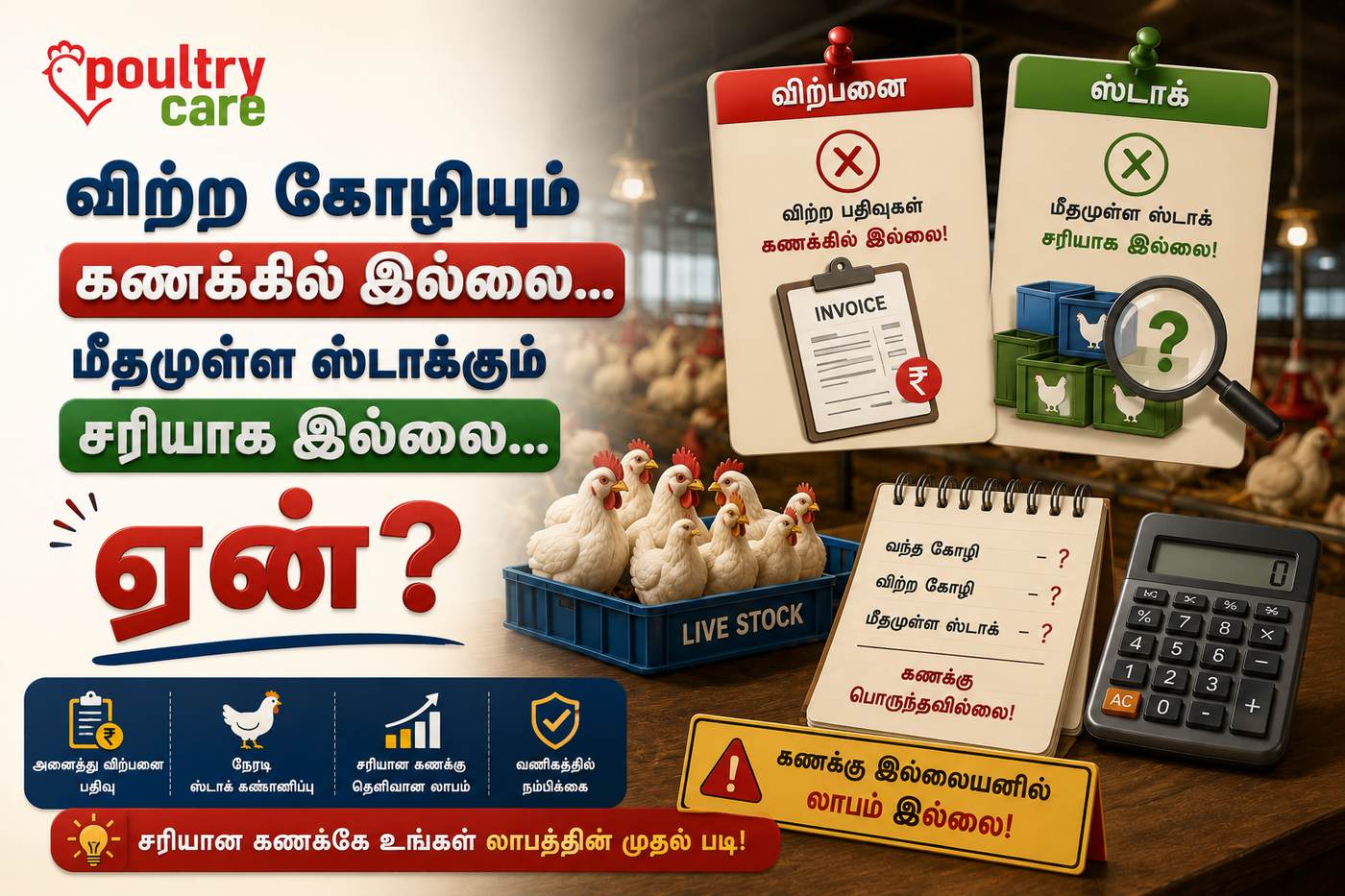

When Sales Happen Fast but Money Moves Slow
Every poultry farmer knows this situation.
Birds are grown successfully. Buyers are confirmed. Loading happens on time. Delivery reaches the market without delay. Everything appears smooth until one question arises.
When will payment come?
Days pass. Calls begin. Accounts teams follow up. Traders promise settlement soon. Customers say they are verifying quantities. Slowly, tension builds between all parties involved.
The surprising truth is that late payment rarely happens because someone refuses to pay. Most delays begin much earlier, during operations themselves.
Payment problems are usually not financial problems. They are information problems.
The Hidden Gap Between Delivery and Billing
In poultry trading, the journey between farm and payment includes several invisible steps. Birds move physically within hours, but transaction confirmation takes much longer.
After delivery, multiple verifications begin. Buyers check received quantities. Traders compare loading records. Weight differences are discussed. Mortality during transport may be questioned. Market rate adjustments sometimes enter the conversation.
If any detail is unclear, billing pauses.
Even a small mismatch between dispatched stock and received stock creates hesitation. Buyers wait for confirmation before releasing funds. Traders delay invoices until clarity is achieved. Farmers remain stuck in uncertainty.
The delay is not intentional. It is created by missing alignment between operations and records.
How Small Confusions Become Big Payment Delays
Payment delays rarely start with large mistakes. They begin with small uncertainties.
A loading count written later instead of immediately. A delivery confirmation shared verbally rather than recorded. A weight slip arriving after invoicing discussion has started.
Each small gap forces another round of verification.
One phone call becomes five. One clarification becomes multiple discussions involving different teams.
While everyone tries to confirm facts, payment naturally moves to the background.
In fast-moving poultry trading, uncertainty slows money faster than market fluctuations.
Why Trust Alone Cannot Sustain Trading Growth
Many poultry businesses operate on long-term relationships. Trust plays an important role, especially in regional trading networks.
But as business volume grows, dependency on trust alone becomes risky.
Earlier, when transactions were smaller, memory and relationships were enough to manage settlements. Today, higher volumes and frequent deliveries make manual tracking difficult.
Even trusted partners begin requesting confirmation because their own accounts must balance.
Late payments then create emotional strain. Farmers feel buyers are delaying intentionally. Buyers feel pressure due to unclear records. Traders stand between both sides trying to resolve confusion.
The real issue is not trust breaking. It is visibility reducing.
The Chain Reaction Created by Delayed Payments
Late payments do not stop at accounting departments. They affect the entire poultry ecosystem.
Farmers struggle to purchase feed on time. Operational planning becomes uncertain. Staff payments and logistics expenses get postponed. Future flock decisions become cautious.
Cash flow interruptions reduce confidence in expansion.
Over time, farmers may avoid good market opportunities simply because previous payments are still pending.
Thus, payment delay quietly slows business growth without appearing as a major operational issue.
Where Coordination Usually Breaks Down
Payment speed depends heavily on coordination between farm operations, trading teams, and customers.
When these groups work independently, information travels slowly. Dispatch teams focus only on loading. Accounts teams wait for confirmation. Customers verify separately.
Without synchronized communication, each department waits for another to confirm details.
This waiting period creates invisible delays.
Payment moves only after everyone feels confident about quantities, quality, and pricing alignment. Until then, transactions remain incomplete even though birds were delivered successfully.
Why Documentation Timing Matters More Than Documentation Itself
Many farmers believe maintaining records is enough. But in trading management, timing matters more than existence.
Records created after operations rely on memory. Memory changes under pressure. Small estimation differences appear.
When billing begins, these differences surface as disputes.
Accurate documentation done at the moment of activity removes doubt later. Immediate confirmation builds confidence across the supply chain.
When everyone sees the same information at the same time, payment discussions become smoother.
Clarity accelerates financial movement.
How Transparency Improves Payment Behavior
Transparency changes how buyers respond.
When delivery details are clear and traceable, customers feel comfortable releasing payments faster. They spend less time verifying and more time continuing business.
Clear transactions reduce defensive conversations. Instead of questioning numbers, partners focus on planning future orders.
Transparency transforms payment from negotiation into routine process.
Over time, businesses known for clarity experience stronger relationships and faster settlements.
Moving from Follow-Ups to Predictable Cash Flow
Many farmers spend significant time following up for payments. Calls, reminders, and repeated discussions become part of daily routine.
But sustainable trading businesses aim for predictability rather than follow-ups.
Predictable cash flow happens when operational clarity supports financial confidence. When transactions are visible, disputes reduce. When disputes reduce, payment cycles stabilize.
The shift is not about forcing customers to pay faster. It is about removing reasons for delay.
When uncertainty disappears, payment naturally accelerates.
The Real Meaning of Payment Discipline
Payment discipline is often misunderstood as strict collection behavior. In reality, discipline begins inside operations.
Clear loading records. Confirmed deliveries. Aligned stock data. Transparent communication.
These operational habits create financial discipline automatically.
Farmers who focus only on payment collection address the symptom. Farmers who improve coordination solve the root cause.
The difference becomes visible in long-term business stability.
Conclusion
Late payments in poultry trading are rarely caused by unwilling buyers or weak relationships. They are usually the result of gaps between operations, records, and communication.
When stock movement, delivery confirmation, and billing information are aligned, payment delays reduce naturally.
Improving coordination does more than speed up cash flow. It strengthens trust, improves planning confidence, and allows farmers to focus on growth instead of recovery.
In poultry trading, money moves at the speed of clarity.