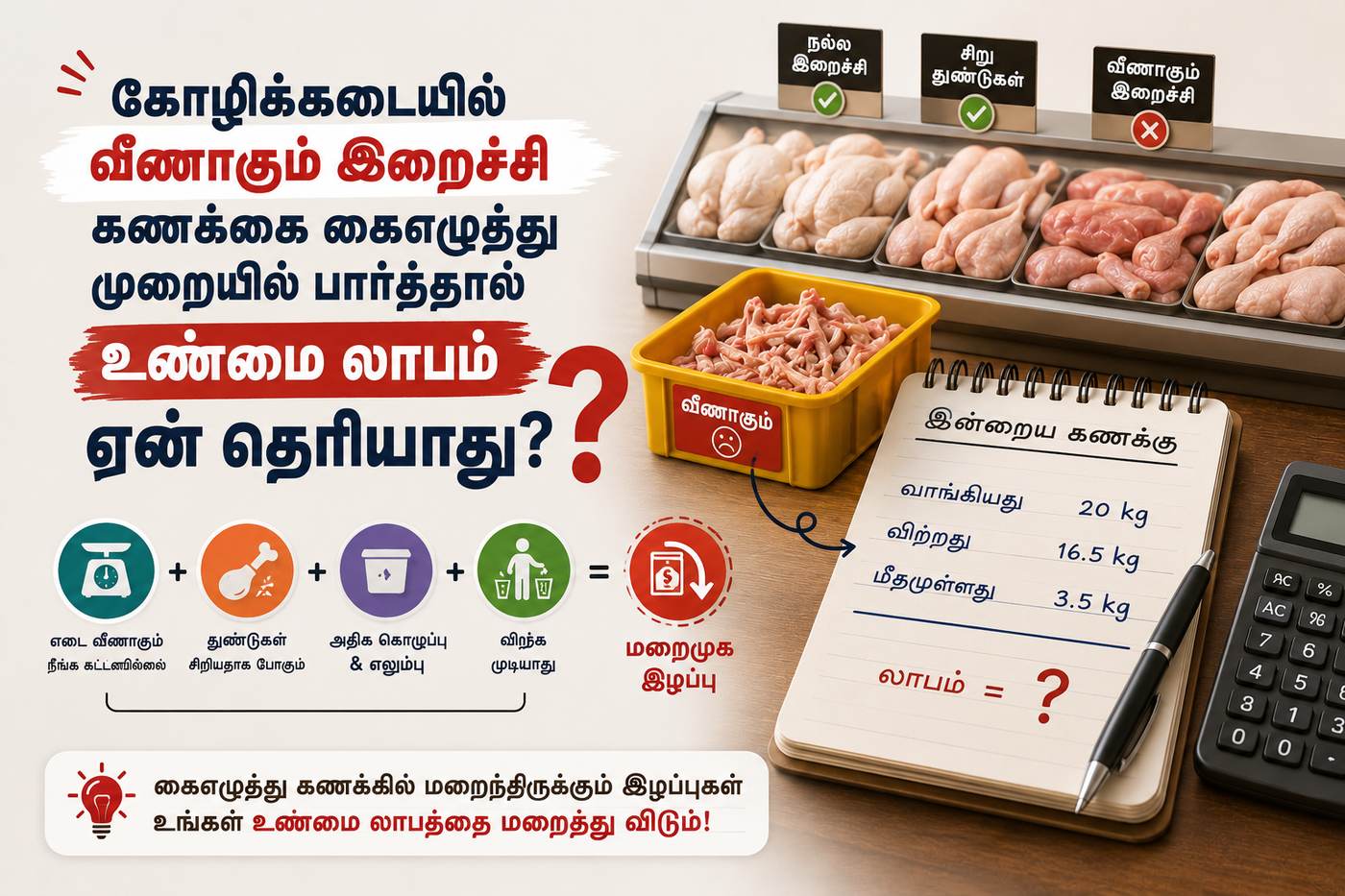

In poultry trading, most losses don’t come like a storm. They come like slow dripping water.
One crate loses a little weight. One trip lands slightly lower. One batch shows small shrinkage. Nobody panics — because each loss looks “too small to worry.”
But here is the field truth: small losses repeated daily become big monthly damage.
Many traders focus only on rate difference and bird price negotiation. Very few calculate shrinkage impact across total volume. That is where hidden profit leakage lives.
After working closely with poultry traders, farm owners, and integrators, one pattern is very clear — weight loss is not just a biological factor. It is also a management signal.
Let us break this in practical poultry language.
Why Small Shrinkage Feels Harmless — But Is Not
When a trader sees 20–30 grams drop per bird, it doesn’t look dangerous. It feels acceptable. Sometimes it is even expected.
But poultry trading is a volume business. Profit is not made on one bird — it is made on thousands.
Let us look at a simple ground example.
If 2,000 birds lose just 25 grams each, that is 50 kilograms gone.
If this happens across 20 trading days, that becomes 1,000 kilograms.
That is one full ton of sellable weight lost in a month.
Nobody steals it. No record shows it clearly. But margin disappears.
This is why experienced traders respect small numbers.
They know — poultry profit hides inside grams.
Where These Small Losses Usually Start
Shrinkage does not begin in transport alone. It starts from preparation stage itself.
Birds that are caught roughly burn more energy. Birds that wait too long before loading lose more moisture. Birds that stay without water longer lose more body mass.
Then comes crate loading practice. Slight overcrowding repeated across many crates multiplies stress. Stress increases respiration. Respiration increases water loss.
Then comes timing mismatch — catching early, dispatching late, unloading slow.
Each step causes a small drop. Combined, they create a big outcome.
Loss rarely has one big cause. It usually has many small careless causes.
Why Traders Don’t Notice the Real Impact
Most poultry traders track purchase weight and sale weight — but not shrinkage pattern.
Bills get adjusted. Rates get negotiated. Transactions close. Nobody studies the trend.
Because loss is distributed across trips and days, it hides easily.
Also, poultry trading culture often accepts shrinkage as “normal adjustment.” When something becomes normal, nobody questions it.
But smart business always questions repeated adjustments.
Field-smart traders compare trip-wise arrival percentages. They notice which routes, teams, and timings consistently land better weight. That observation alone improves margin.
Not by luck — by awareness.
Transport and Waiting Time Multiply Micro Losses
Many think distance causes weight loss. But time under stress causes more damage than distance alone.
A short trip with long waiting at market can create more shrinkage than a longer direct delivery.
Standing-loaded vehicles under heat, traffic halts, unloading delays — these are silent multipliers.
Birds don’t lose weight only while moving. They lose weight while waiting stressed.
This is why transport planning is profit planning.
Coordinated dispatch and confirmed unloading slots reduce shrinkage more than speed driving.
Season Effect — Small Difference Becomes Big Pattern
Shrinkage patterns change with season, but trading methods often don’t change accordingly.
In hot months, dehydration loss is faster. In cold months, energy burn is higher. If crate density, timing, and transport ventilation are not adjusted, repeated small seasonal loss becomes a monthly trend.
Experienced poultry handlers change:
-
Loading time
-
Bird density per crate
-
Vehicle airflow
-
Travel schedule
They don’t call it science. They call it experience. But it is actually profit protection behavior.
Season-smart traders lose less without realizing why — because they adjust early.
The Compound Effect — Why Monthly Review Matters
The biggest mistake in poultry trading is reviewing performance only by cash flow — not by weight flow.
Cash shows result. Weight shows reason.
When traders review monthly total dispatch weight vs total arrival weight, the picture becomes clear. Even a 1–2% consistent shrinkage difference between routes or teams is huge across volume.
Compound effect is powerful — both in profit and in loss.
Small daily inefficiency × large volume × many days = serious business impact.
Monthly shrinkage tracking should be as routine as rate tracking.
How Practical Traders Reduce Shrinkage Without Complexity
You don’t need complex systems first. You need discipline first.
Good traders standardize catching method. They train handling teams. They define crate limits. They coordinate dispatch timing with buyers. They record arrival variance.
They ask simple questions repeatedly:
Which trip landed best weight?
Which vehicle gave least shrinkage?
Which timing worked better?
Which team handled better?
Better questions create better margin.
Improvement in poultry trading is rarely dramatic. It is gradual and measurable.
Final Field Truth — Profit Leakage Is Quiet, But Controllable
In poultry trading, nobody plans to lose profit. But many allow silent loss by ignoring small numbers.
Small weight loss is not just a transport outcome — it is a process indicator.
When traders start seeing shrinkage as a management metric instead of a routine adjustment, decisions change. Handling improves. Timing improves. Coordination improves.
And when process improves, margin follows.
Remember this simple line from field experience:
Big losses shout.
Small losses repeat.
Repeated small losses build the biggest damage.
Smart poultry traders don’t chase only better price.
They protect better weight.