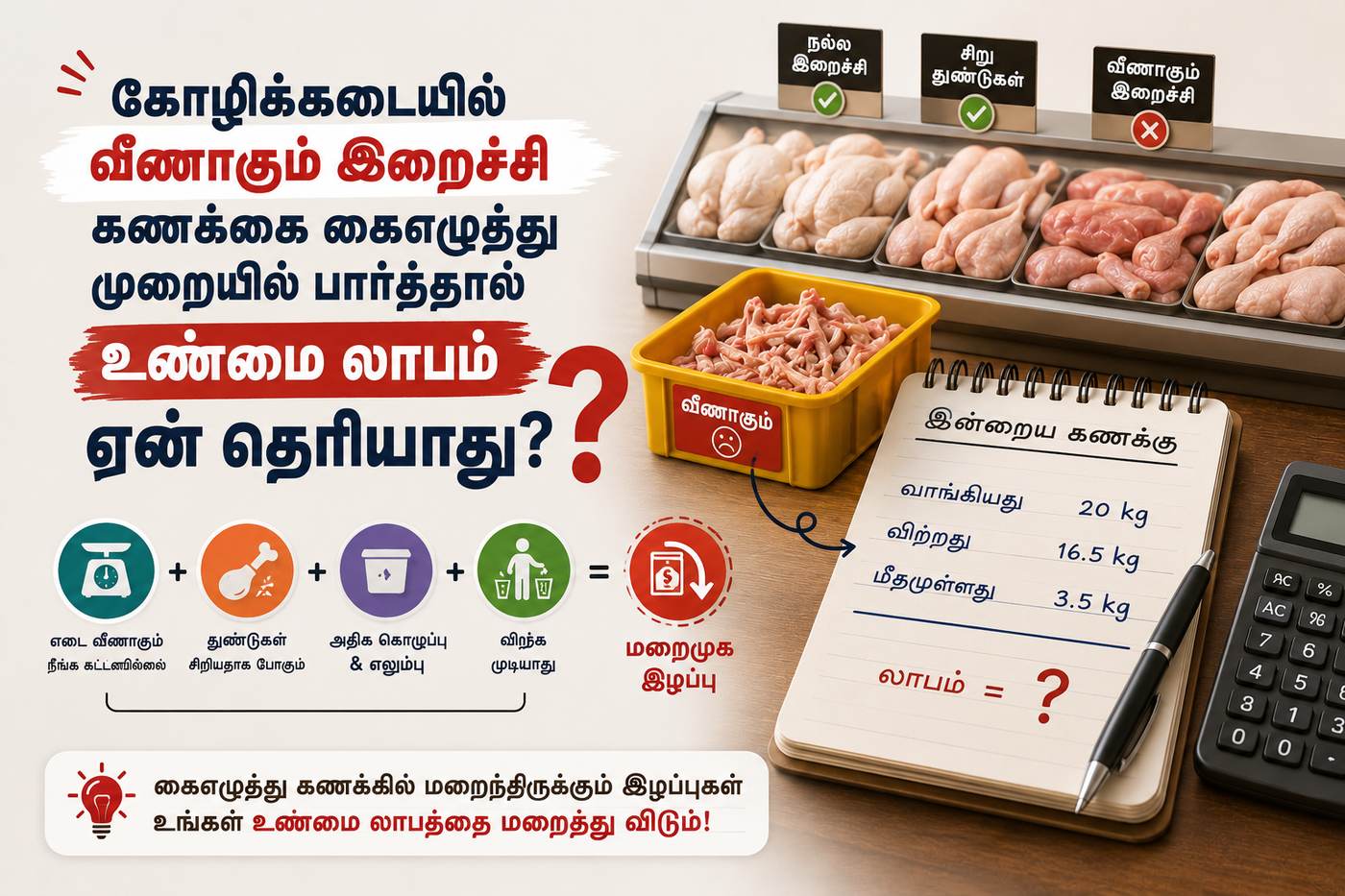

Every morning in poultry trading starts with activity. Birds move out, vehicles roll in, markets open, and deals are made quickly. The business feels alive. At the end of the day, there is money movement, phone calls settle prices, and the cycle begins again the next morning.
Yet many traders quietly feel something is off. Despite daily sales and continuous effort, profits don’t grow the way they should. The business runs, but the results don’t fully reflect the hard work put in. This leads to a question most traders sense but rarely stop to ask clearly—where does daily profit slowly leak?
This blog is written to slow the pace just enough to see what usually goes unnoticed. It doesn’t promise shortcuts or quick fixes. Instead, it brings clarity to the small, everyday gaps that silently decide long-term trading success.
Why Daily Profit Loss Is Hard to Notice
Poultry trading operates at speed. Decisions are made fast, margins are thin, and volume is high. When business moves this quickly, small losses feel insignificant. A little weight loss here, a small transport variation there—it all feels like part of the trade.
The problem is not one big mistake. The problem is repetition. When small losses repeat daily, they quietly turn into structural damage. Because nothing dramatic happens on any single day, traders rarely stop to investigate deeper.
Over time, effort increases but satisfaction decreases. This is often the first sign that profit is leaking somewhere beneath the surface.
The Comfort of Busy Business
A busy trading operation creates emotional comfort. When trucks are moving and buyers are calling, the business feels healthy. This sense of motion can be misleading.
Activity does not equal profitability. Many traders confuse the two because they happen together. But profit is not created by movement alone. It is created by what remains after movement is complete.
When traders measure success by how busy the day was, instead of what the day actually delivered, blind spots begin to grow.
Invisible Losses Between Buy and Sell
Most traders track buying price and selling price closely. That gap feels like the profit zone. But real profit lives in everything that happens between those two points.
Losses during loading, minor handling stress, transport inefficiencies, delayed dispatches, market deductions, and settlement variations all occur quietly. None of them feel large enough to panic over. But together, they reshape the final outcome.
Because these losses don’t happen at the same time or place, they are rarely seen as a single problem. They remain scattered, unchallenged, and accepted as normal.
Weight, Time, and Timing: The Silent Triangle
In poultry trading, weight is money, time is money, and timing decides both. Small delays during loading or market entry often reduce bird quality and weight. Market timing affects pricing more than most traders admit.
When these factors are not observed together, traders miss their combined impact. A slightly delayed sale at a slightly weaker price with slightly higher stress loss doesn’t look alarming. But repeated daily, it becomes a steady drain.
The danger lies not in the loss itself, but in how easily it blends into routine.
Cash Flow That Hides Reality
Regular cash flow creates confidence. When payments arrive, even if delayed, traders feel reassured. But cash flow does not always reflect profitability.
Credit sales, rolling settlements, and partial payments distort visibility. A trader may feel profitable because money keeps coming in, while actual margins shrink silently.
When cash flow replaces margin analysis, decisions become emotional rather than informed. Over time, this weakens the foundation of the business.
When Experience Becomes a Blindfold
Experience is powerful in poultry trading. Seasoned traders develop instincts that help them survive volatile markets. But experience can also turn into habit.
When traders rely only on what has “always worked,” they stop questioning small inefficiencies. Markets change, costs evolve, and buyer behavior shifts—but habits remain the same.
True expertise is not just knowing what to do. It is knowing when to re-evaluate what feels familiar.
Segment Mixing and Hidden Cross-Subsidy
Many traders operate across multiple trading activities—different bird types, markets, or regions. Often, profits from one segment quietly cover losses in another.
Because results are viewed as a whole, underperforming segments escape attention. Traders feel stable overall, but growth stalls because leaks are never isolated or corrected.
Clarity emerges only when each activity is understood on its own merit.
From Leakage to Control
Profit leakage is not a sign of failure. It is a sign of missing visibility. The moment traders stop assuming and start observing, patterns begin to appear.
Control doesn’t come from working harder. It comes from understanding where effort produces results and where it quietly dissolves.
Once daily leaks are identified, improvement becomes realistic, not overwhelming.
Conclusion: Profit Is Protected Daily, Not Recovered Later
In poultry trading, profit doesn’t disappear overnight. It leaks slowly, quietly, and consistently. By the time it is noticed, months of opportunity are already gone.
Traders who grow sustainably are not those who chase the highest prices. They are those who protect daily margins with awareness and discipline.
When attention shifts from “how much did I sell” to “what truly stayed,” trading transforms from survival into strategy.