
Why Many Poultry Shops Work Hard but Still Feel Profit Pressure
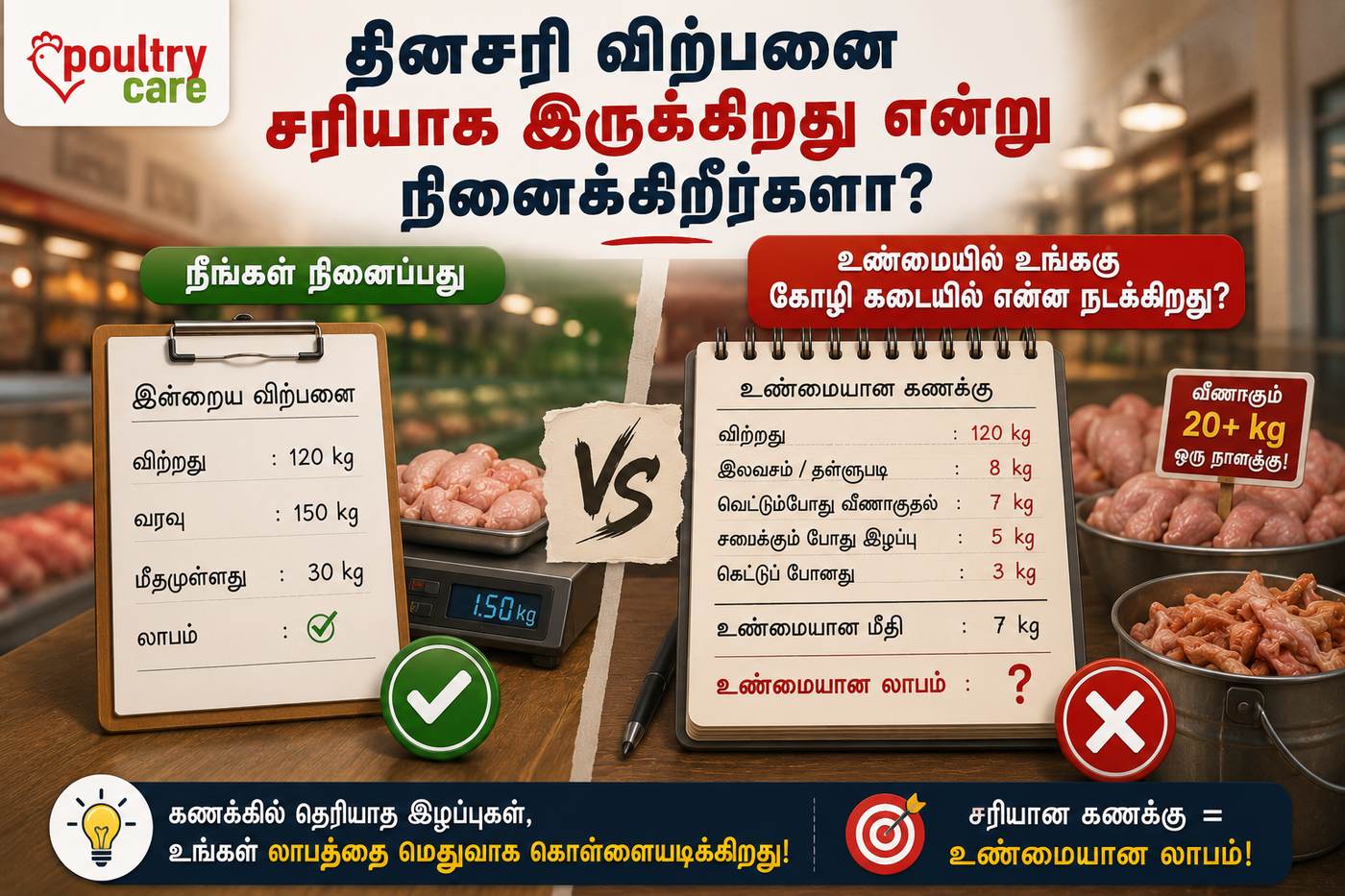
Across many poultry retail shops, owners share a similar experience. Sales are happening. Customers are regular. Daily collections look satisfactory. Yet savings do not grow as expected.
At first, market price is blamed. Then purchase cost is questioned. Sometimes staff efficiency becomes the concern. But after observing many retail operations closely, one common reality appears.
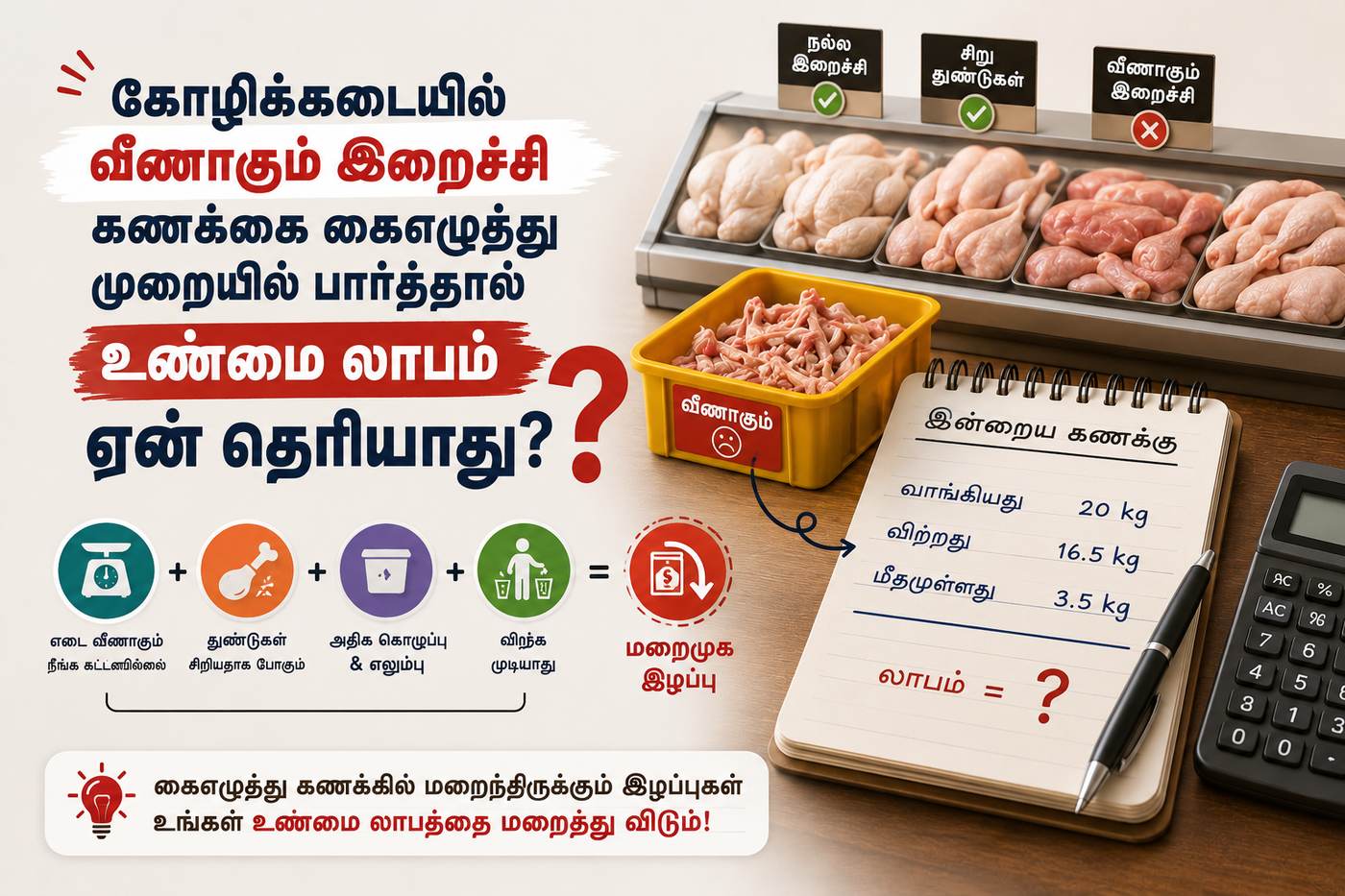
Most shop owners know how much money they spend and earn, but very few clearly know how much weight they actually lose.
In poultry retail, profit is not decided only by selling price. It is strongly influenced by how much sellable weight remains after processing and handling.
This hidden reduction is called shrinkage.
Understanding shrinkage becomes powerful only when it is measured. And measurement begins with one simple calculation — shrinkage percentage.
Once a retailer learns how to calculate it, business clarity improves immediately.
What Exactly Is Poultry Shrinkage Percentage
Shrinkage percentage shows how much weight is lost between purchase and final sale.
It converts invisible loss into a visible number.
Without calculation, shrinkage feels like a normal part of business. With calculation, it becomes measurable and controllable.
When birds or dressed meat arrive at the shop, they carry a certain weight. After slaughtering, cleaning, cutting, storing, and selling, the final billable weight becomes lower.
The percentage difference between these two weights is called shrinkage percentage.
This number answers an important question every retailer should know:
How much of what I purchase actually becomes revenue?
Many retailers are surprised when they first calculate this value because the loss is often higher than expected.
But awareness is the first step toward improvement.
Why Calculating Shrinkage Changes Retail Decision Making
Retailers usually adjust selling price based on market competition. However, without knowing shrinkage percentage, pricing decisions are made blindly.
If shrinkage increases even slightly, actual cost per kilogram rises automatically.
For example, if weight loss increases but selling price remains unchanged, profit margin silently reduces. Over weeks and months, this creates financial pressure even when sales volume stays constant.
Calculation brings clarity.
When shrinkage percentage is known, retailers understand:
their true cost per kilogram,
whether handling practices are efficient,
and whether operational changes are required.
Instead of guessing profit, the retailer begins managing profit scientifically.
This shift transforms daily shop activity into structured retail management.
Step-by-Step Method to Calculate Poultry Shrinkage Percentage
The calculation itself is simple. What matters is consistency in recording weights.
First, record the total purchase weight. This includes the full weight of birds or dressed meat received at the shop before processing begins.
Next, record the total saleable weight. This is the actual weight billed to customers after cutting and selling.
Once both values are known, shrinkage percentage can be calculated using a simple formula.
Shrinkage Percentage equals Purchase Weight minus Sale Weight divided by Purchase Weight multiplied by one hundred.
Shrinkage % = (Purchase Weight − Sale Weight) ÷ Purchase Weight × 100
Let us understand this with a practical shop example.
A retailer purchases one hundred kilograms of poultry.
After processing and selling throughout the day, total billed weight becomes ninety-five kilograms.
The weight difference is five kilograms.
Now applying the formula:
Five divided by one hundred multiplied by one hundred equals five percent.
This means the shop experienced five percent shrinkage.
This single number reveals operational efficiency for the day.
When calculated daily or weekly, patterns begin to appear. Some days may show higher loss due to handling variation or storage conditions.
Measurement turns assumptions into knowledge.
Common Mistakes Retailers Make While Calculating Shrinkage
Many shop owners attempt calculation once but later stop because results appear inconsistent. Usually, the problem lies not in the formula but in recording practices.
One common mistake is mixing live weight and dressed weight. Both must be compared correctly to avoid confusion.
Another issue is inaccurate weighing. Scales that are not calibrated regularly create misleading numbers.
Some retailers forget to include unsold closing stock. Remaining inventory still carries weight value and must be considered when calculating saleable quantity.
Timing differences also affect accuracy. Purchase weight should always be recorded immediately upon receiving goods, not after processing begins.
Small recording gaps create large calculation errors.
Consistency matters more than perfection. Even approximate daily tracking provides valuable insight when done regularly.
How Shrinkage Percentage Helps Improve Daily Operations
Once shrinkage percentage becomes visible, operational improvements naturally follow.
Retailers begin observing which processes cause higher loss. Cutting practices become more standardized. Staff handling improves because weight awareness increases.
Storage discipline strengthens when owners see how temperature variation influences shrinkage numbers.
Purchase planning also improves. Instead of overstocking and facing overnight moisture loss, retailers align buying quantity with sales speed.
Gradually, profit improves without increasing selling price or customer count.
This is the power of measurement.
Many successful retail businesses grow not by selling more but by losing less.
Shrinkage percentage acts like a health report for the shop. It shows whether operations are efficient or leaking value.
Building a Habit of Daily Shrinkage Monitoring
Calculation should not be treated as an occasional exercise. Its true benefit appears when it becomes a routine habit.
Daily monitoring builds operational awareness. Weekly comparison identifies patterns. Monthly observation reveals improvement trends.
Retail owners who track shrinkage regularly gain confidence in pricing decisions. They understand their real margin instead of estimating it.
Staff also become partners in efficiency when performance is measured transparently.
Over time, shrinkage monitoring changes shop culture. Work becomes more organized, waste reduces, and profitability stabilizes.
Retail management evolves from experience-based decisions to knowledge-based decisions.
Conclusion: Numbers Bring Clarity to Retail Profit
Poultry retail is a business of kilograms, not just customers.
Every kilogram lost before billing directly affects earnings. Yet many retailers operate without measuring this loss.
Learning how to calculate shrinkage percentage is a simple step, but its impact is powerful. It converts hidden loss into visible insight.
Once shrinkage becomes measurable, improvement becomes possible.
Before ending today’s business, consider checking one thing — do you know your shop’s shrinkage percentage?
That single number may explain many profit questions you have been thinking about for years.
Retail growth does not always require expansion. Sometimes, it begins with understanding what already happens inside your shop.
When weight is measured correctly, profit starts becoming predictable.