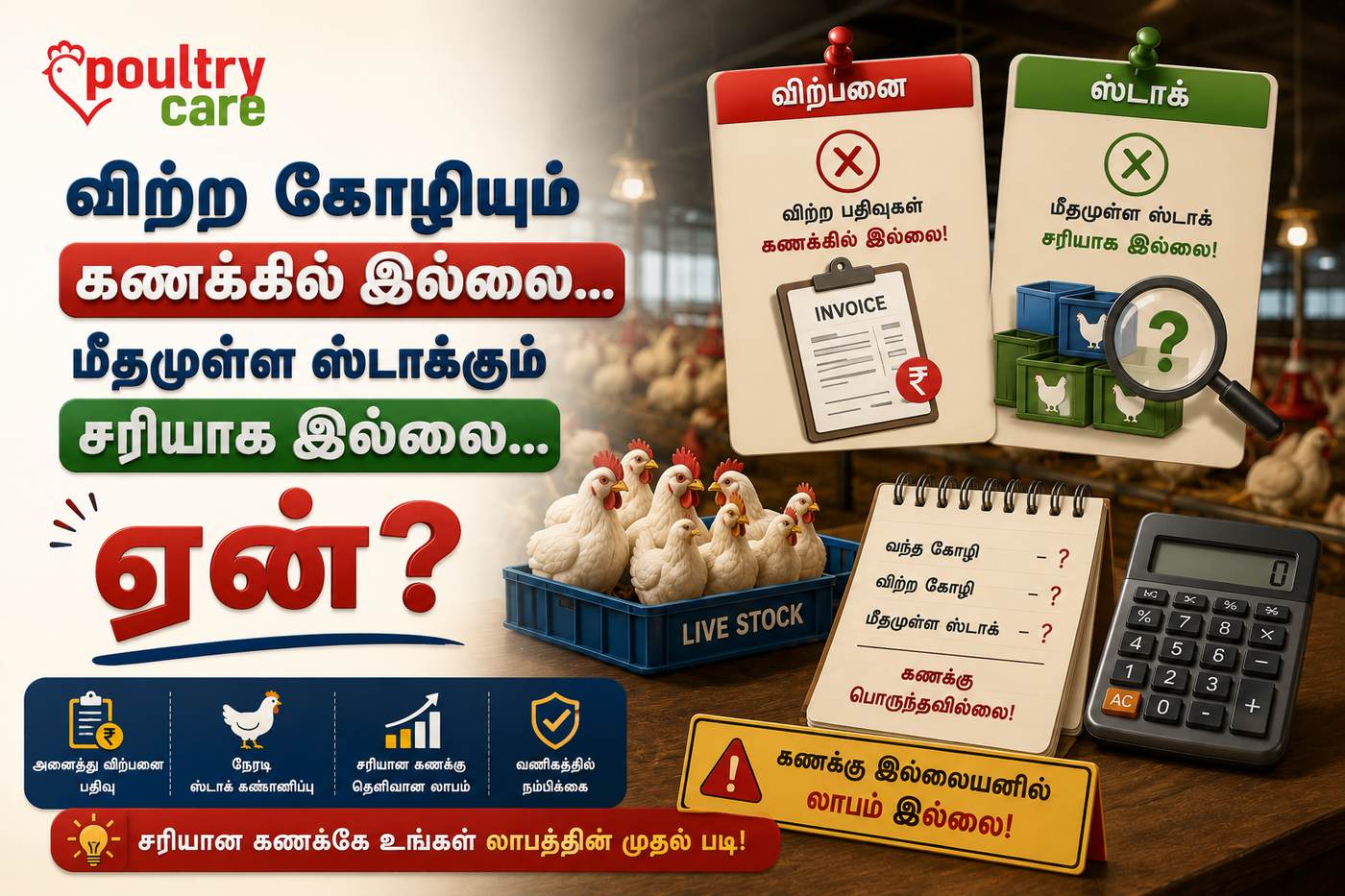

“ஸ்டாக் இருக்குன்னு நினைக்கிறோம்… ஆனா கடைசில எங்கே போச்சு?”
Let us start with a simple calculation that every poultry trader has faced.
If your records show 1,200 birds available, but physically only 1,180 birds are present, 20 birds are already lost. If one bird is worth 180, the loss is 3,600 in a single day. If this happens twice a week, the monthly loss easily crosses 25,000.
Most traders notice this difference only during adjustment or month-end review. By that time, the birds are gone and the money is gone. This is why stock clarity is one of the most critical controls in poultry trading.
Why Stock Confusion Is So Common in Poultry Trading
Poultry trading moves fast. Birds come in, birds go out, and movement happens throughout the day. Purchases, sales, deaths, returns, and transfers all happen continuously.
When stock is updated later or remembered from memory, confusion becomes natural. Traders believe stock is available, but during sale they suddenly realize shortage. This creates panic, emergency buying, and broken customer commitments.
Stock confusion does not happen because traders are careless. It happens because information is not updated at the same speed as bird movement.
How Delayed Stock Updates Turn Small Differences into Big Loss
When stock is updated at the end of the day, loss becomes invisible. A few birds missing here, a small weight difference there, everything gets adjusted.
Adjustment closes the book, but it does not close the loss.
Delayed updates also affect planning. Traders may sell birds that are not physically available or purchase birds unnecessarily. Both situations increase cost, stress, and risk.
When decisions are made using old stock information, mistakes repeat daily.
The Direct Link Between Stock Visibility and Profit
Stock accuracy and profit accuracy are directly connected. When stock numbers are wrong, profit numbers are also wrong.
Many traders feel margins are reducing due to market pressure, but the real reason is untracked stock loss. When birds disappear silently, profit disappears silently.
Real-time stock tracking shows what is actually available now, not what should be available. This clarity helps traders avoid emergency purchases, unnecessary discounts, and customer disputes.
Profit improves not by selling more, but by losing less.
Why Traders Depend on Adjustment Instead of Accuracy
Adjustment feels easier than investigation. It avoids arguments and saves time in the short term. But it creates long-term damage.
When adjustment becomes routine, accuracy disappears. Traders stop asking why stock differs. Loss becomes normal.
Real-time stock tracking reduces the need for adjustment. When movement is recorded immediately, differences are noticed early and corrected early.
The 1% Improvement That Changes Stock Control Without Stress
Kotler teaches that people change not through big jumps, but through small, safe steps.
So instead of changing everything at once, start with a simple 1% improvement.
Check and confirm stock one extra time each day.
Not at month end.
Not after a problem.
Just once more during the day.
If birds are purchased in the morning, pause before evening sales and ask one question.
“How many birds do I actually have right now?”
This five-minute habit creates awareness. Awareness changes behavior.
Staff become more careful.
Adjustments reduce.
Loss becomes visible.
This is progressive commitment. A small habit that builds confidence and leads to better control.
Many traders later say quietly,
“இவ்வளவு சின்ன விஷயம் இவ்வளவு மாற்றம் பண்ணுதே.”
The Emotional Stress of Stock Uncertainty
Stock uncertainty creates constant mental pressure. Traders hesitate while confirming orders. They fear saying yes to customers because they are not fully sure.
Many traders feel,
“ஸ்டாக் சரியா தெரியாததாலேயே நிம்மதி இல்ல.”
This stress affects confidence and relationships. When stock becomes clear, this pressure reduces automatically.
What Changes When Stock Is Known at Every Moment
When traders know their stock clearly, confidence improves. They commit to customers calmly. They plan purchases logically. They stop firefighting and start managing.
Loss does not stop overnight, but it reduces steadily. Discipline improves. Profit stabilizes.
Real-time stock tracking does not complicate trading. It simplifies it.
Conclusion: Stock Clarity Begins with One Small Habit
In poultry trading, stock confusion is a silent profit killer. Every unaccounted bird is money lost.
Big change does not start with big systems. It starts with one small habit done daily.
That one extra stock check is a 1% improvement.
That 1% builds awareness.
Awareness builds control.
And control is what turns hard work into real profit.